
This video was recently uploaded to YouTube. I've never seen such an extensive video of Tohei sensei performing jo katas before. Very interesting to watch.
Showing posts with label tohei. Show all posts
Showing posts with label tohei. Show all posts
Thursday, 5 February 2015

Friday, 27 June 2014
Memories of Koichi Tohei, David Currie and Aikido in Italy
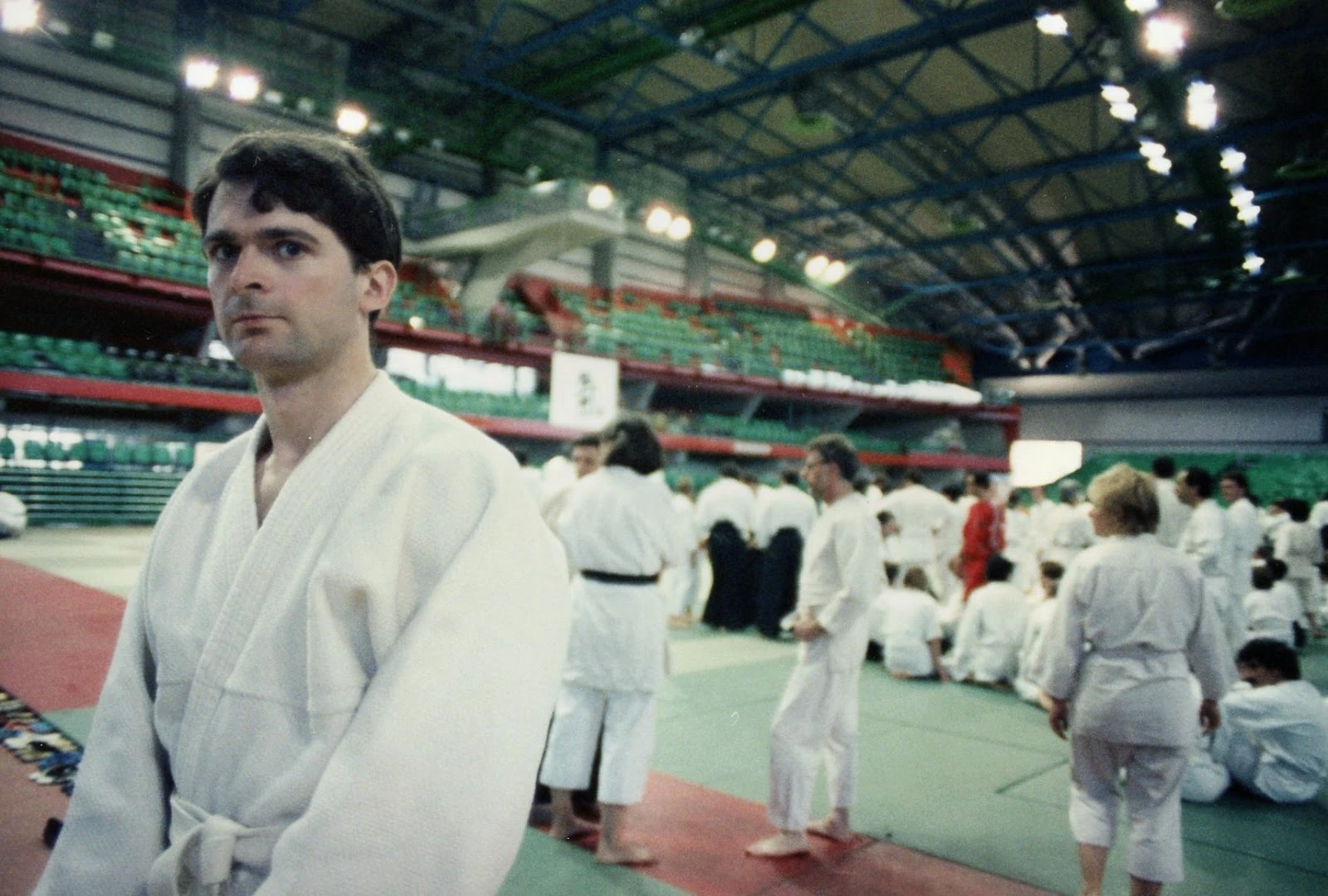
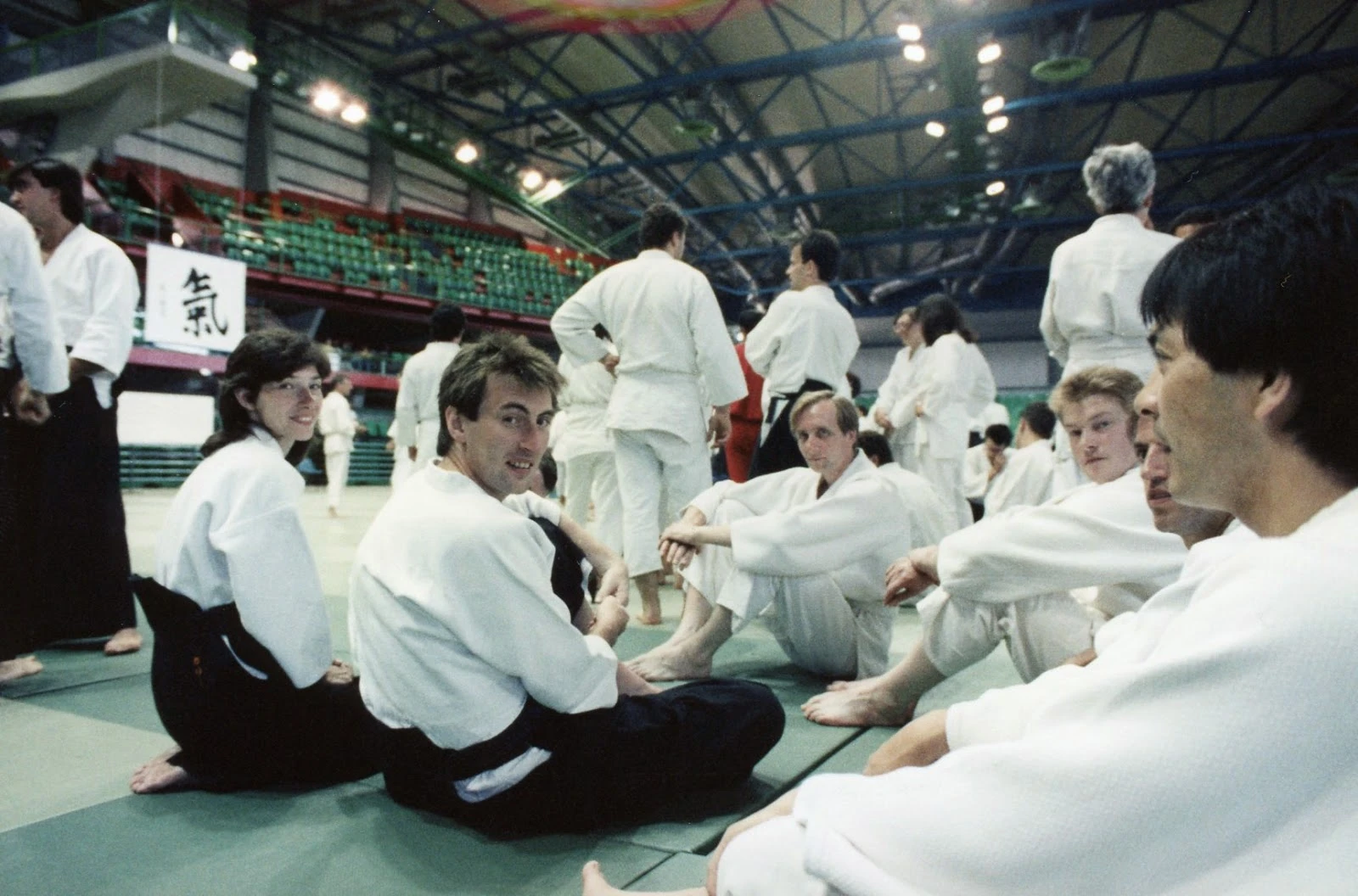
I just came across a batch of old photos that I hadn't seen in years. These are of the visit our Aikido Club made in 1987 to Florence, Italy (see here) to study at a seminar with Koichi Tohei Sensei. Great memories... if anyone who was there happens to see this blog post, please get in touch. And if you have more photos, well, I'd love to see them!
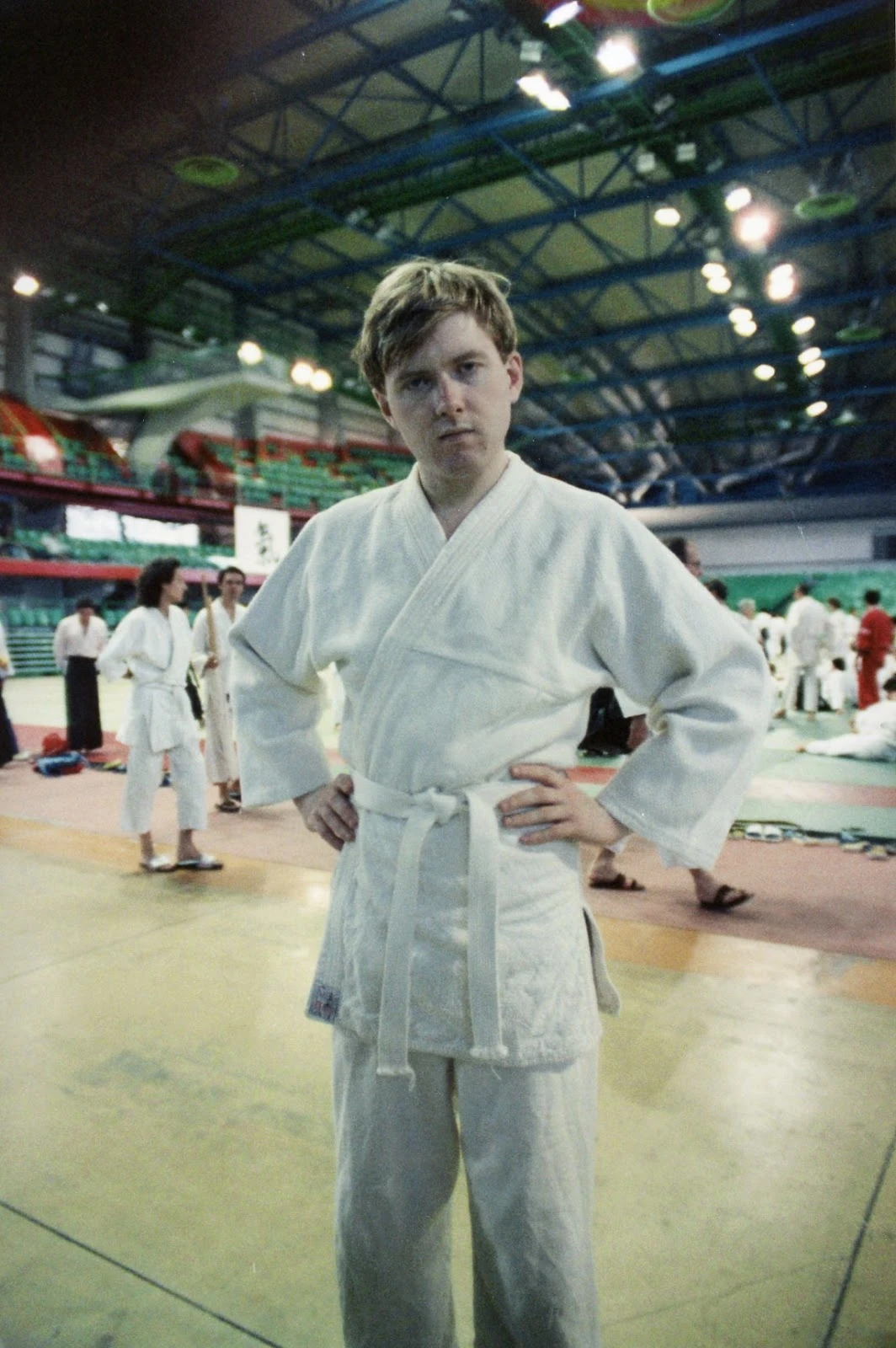
Me posing as a white belt (I think I was brown belt at the time?)
Dermot (still to be found at the Hartland Club). He had only recently started aikido but decided to come along anyway - a wise choice as this was a once-in-a-lifetime opportunity.
My teacher, David Currie (foreground left, smiling at camera) and his wife Sue alongside. Various other old aikido chums (Maurice at centre back, Dennis, looking at camera on right). Happy days!
Friday, 10 January 2014
Tohei Sensei Aikido video, 1957
Someone recently posted this video of Tohei Sensei showing a mix of exercises and techniques back in 1957. I thought some of you might find it interesting.
Tuesday, 12 November 2013
Koichi Tohei, rare historic video
I just came across this old video (from 1962 I think) of Koichi Tohei who was at that time the Founder's chief instructor but who later went on to develop the style popularly known as 'Ki Aikido'. In this video, Tohei shows a variety of exercises, throws and also some jo-dori and knife defences. The thing I find fascinating about Tohei is how 'natural' he looks. He never adopts a 'martial arts' stance. He just seems to be walking around without a care in the world but happening to throw people as they attack. It is that relaxed 'naturalness' that fascinates me and it is a quality to which I (perhaps vainly?) aspire. At any rate, see what you think...
Sunday, 26 May 2013
Tohei Sensei - memories of 1987
You know, it's often the ephemera - the disposable bits and pieces that had once seemed of no importance - that can really bring memories of the past rushing back. And so it was for me this week when, having decided to sort out some old boxes containing 'rubbish', I chanced upon this...
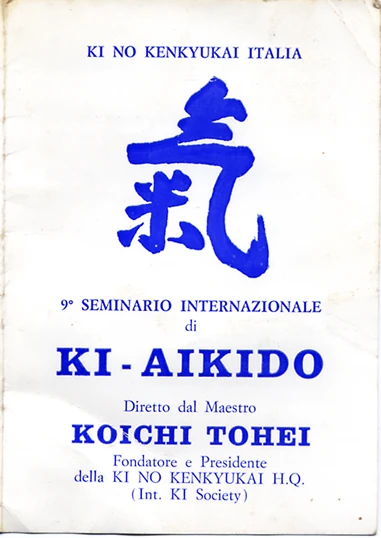
It's just a crumpled piece of folded cardboard. And yet it immediately brought back very vivid memories from 1987 (and it seems hard to believe that it was really that long ago!). In the summer of that year, some members of our Aikido Club from London decided to take a holiday in Italy along with our Sensei, David Currie. The reason for the visit was the Aikido seminar being given in Florence by no less than Koichi Tohei, 10th dan and formerly the chief instructor appointed by the founder (O Sensei). Tohei Sensei is now known as the founder of 'Ki Aikido'. Suffice to say, it was (quite literally) a once in a lifetime experience and I now realise how immensely privileged I was to have been a part of it. At any rate, I no longer regard this piece of crumpled cardboard as 'disposable'. From now on, I shall treasure it.
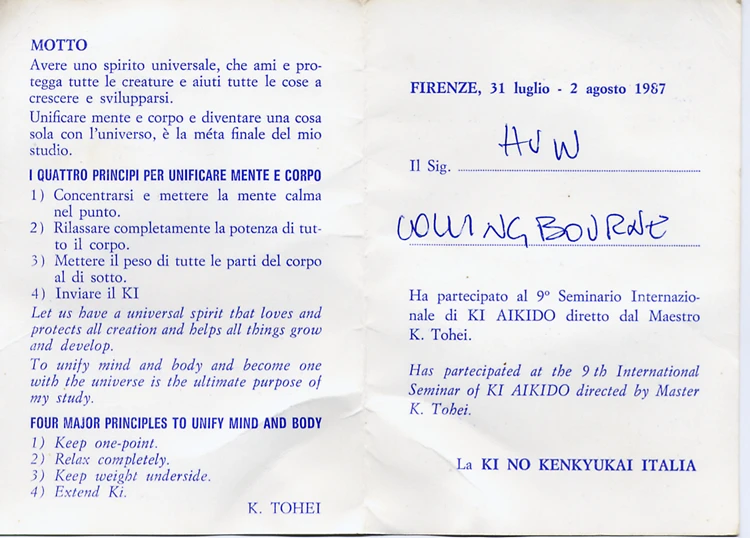
It's just a crumpled piece of folded cardboard. And yet it immediately brought back very vivid memories from 1987 (and it seems hard to believe that it was really that long ago!). In the summer of that year, some members of our Aikido Club from London decided to take a holiday in Italy along with our Sensei, David Currie. The reason for the visit was the Aikido seminar being given in Florence by no less than Koichi Tohei, 10th dan and formerly the chief instructor appointed by the founder (O Sensei). Tohei Sensei is now known as the founder of 'Ki Aikido'. Suffice to say, it was (quite literally) a once in a lifetime experience and I now realise how immensely privileged I was to have been a part of it. At any rate, I no longer regard this piece of crumpled cardboard as 'disposable'. From now on, I shall treasure it.
Saturday, 18 August 2012
Kokyu in Aikido – "Breath power"? Really…?
Kokyu ("呼吸") is a much used word in Aikido. Not only does the term occur in one of the fundamental throws, Kokyu-nage, but it is also used in the exercise, Kokyu-dosa (which, by tradition, should be practised at the end of every Aikido session) and Kokyu-ho (various exercises often involving movement while being held).
Kokyu is the Japanese word for ‘breath’ and many books translate ‘Kokyu-nage’ as ‘the breath throw’ – which seems to suggest that you should be doing some pretty nifty breathing while throwing. It is certainly the case that some people may find ‘kokyu’ exercises, such as kokyu-dosa, easier to do if they breathe in harmony with the technique. Even so, I have to admit that I have never really felt that kokyu-nage involves more or less ‘breath power’ than any other aikido throw.
In Koichi Tohei’s classic book "Aikido, The Co-ordination of Mind and Body for Self-Defence", Kokyu is defined as “movement of your Ki or the movement of your body following Ki.” Tohei says that “The arts of Aikido are concerned not only with physical matters but also with Ki, Kokyu Ho is the way that leads others by Kokyu, and Kokyu Nage is the art of throwing others by Kokyu.”
The one thing you may notice in this description is the complete absence of the word “breath”!
Gozo Shioda, founder of the Yoshinkan school of Aikido describes kokyu power as “focused power” (you can read a free sample chapter on Kokyu from Shioda’s book, ‘Aikido Shugyo: Harmony In Confrontation’ here: http://www.shindokanbooks.com/shugyo.shtml).
To help clarify this confusion, I asked a Japanese friend for some assistance in making sense of the Japanese meaning of the word, kokyu. She tells me that “Kokyu” has four main meanings, the first of which is, indeed, ‘breath’. But it can also mean ‘an art or knack’, ‘the gist of something’ or a ‘rhythm, tone or tune’ and that it may suggest a sense of harmony.
Thinking of kokyu-nage as a throw that uses ‘focused power’ or harmony with Ki makes much more sense to me than its rather prosaically literal translation of ‘breath throw’. This is, after all, what we try to do throughout our practice of Aikido.
Saturday, 5 May 2012
Aikido Books - recommended
People often ask me to recommend books to help them to learn aikido. Here I’ve put together a short list of some of the aikido books that I find most useful and instructive.
Please bear in mind a few important points: 1) I would never recommend trying to learn aikido from a book alone. You must study with a qualified instructor. 2) This list is by no means comprehensive. There are many more books on aikido and some of them may be just as good as the ones listed below. However, these are the books that have proved most useful to me and I have no qualms in recommending them to other people. 3) Different ‘schools’ of Aikido (Ki, Iwama, Yoshinkan etc.) may use different variations on certain techniques. Moreover, each individual teacher may emphasise different approaches or use techniques that differ from those in these books. You should, of course, always follow your teacher’s advice. That said, I am very much of the opinion that students can learn from every great teacher. Even though my own ‘style’ is Ki Aikido, I am very open to learning from teachers of other styles and the books in my list are not all aimed specifically at students of Ki Aikido.
Aikido and The Dynamic Sphere is a superb book. While probably no single book can claim to be the ‘definitive’ reference to aikido, this book comes very close. It is available in hardback and in paperback. Even though it’s expensive, I’d say the hardback edition is worth every penny. It does a great job of describing the techniques of aikido in a coherent and well structured way. But what really makes this book so great are the illustrations. The techniques are superbly illustrated and many of them are annotated with arrows to show the direction of force in each movement. My only caveat is that the book is so detailed that it may be a bit overwhelming for a beginner. However, if you’ve been practising a technique and want to study it in detail outside the dojo, this book cannot be beaten.
Aikido Exercises for Teaching and Training. I’ve only discovered this book quite recently. It was recommended to me by one of the high-ranking teachers in the British Ki Aikido Association – and I am really glad of the recommendation. It’s terrific. In principle, it is aimed at teachers of aikido rather than students and it includes many very useful tips on how to teach certain tricky techniques and how to explain some of the underlying principles. But I have to say that the techniques themselves are so clearly explained that I think this would be a valuable book for learners as well as teachers. But if you are a teacher, consider this essential reading.
Aikido, The Co-ordination of Mind and Body for Self-defense. This is another ‘classic’ text. Written by Koichi Tohei under the supervision of Morihei Ueshiba (the founder of Aikido), the book was published in 1961 when Tohei was the chief instructor at Aikido Headquarters, many years before Tohei went on to found the ‘style’ of Ki Aikido. As a consequence, it may be regarded as an authoritative guide to Aikido as taught by Ueshiba at that time. This is a good reference to the essential techniques including the warm-up and ‘Ki Development’ exercises and it also has some short essays on the philosophy of aikido. It’s pretty well illustrated with some mostly rather grainy black-and-white photographs. Although not as slickly produced as some more modern books, it remains a good reference work. As far as I can see it is not currently in print but second-hand copies are available on Amazon and EBay.
Aikido With Ki. Written by Koretoshi Maruyama under the supervision of Tohei Sensei in the early ‘80s, this book covers, to a large degree, much of the same ground as Tohei’s Aikido (reviewed above). Once again, the essential techniques plus the warm-up and Ki Development exercises are described and photographically illustrated. By the time this book was published, Tohei Sensei had founded the style of Ki Aikido and this book has more explicit references to the principles of “Ki training. The techniques are well explained and – as an added bonus for black belts – there is an appendix on how to fold your hakama. I have to admit that this is one of the arts of aikido that, to this day, I cannot claim to have mastered! As with Tohei’s book, new copies of ‘Aikido With Ki’ may be hard to find but second-hand copies are available.
Now, since I teach Ki Aikido, ‘Dynamic Aikido’ may seem an odd choice. Written by Gozo Shioda, who founded the Yoshinkan school of aikido, several of the techniques described here are substantially different from the techniques as we normally practise them in Ki Aikido. Even the default ‘backward breakfall’ is different. Nevertheless, I have no hesitation in recommending this as one of my top books on aikido.
It’s worth knowing a bit about Shioda in order to understand why and how his style of aikido is a bit different from the style taught in other schools. Shioda was one of Ueshiba’s senior students. He began studying with Ueshiba in the early 1930s and eventually founded the Yoshinkan style in 1955. It is sometimes said that Shioda’s style is representative of an earlier and ‘harder’ style of aikido whereas Tohei’s style is based upon the softer style which Ueshiba developed later in life. Well, maybe there’s some truth in that. Though, anyone who’s practised Ki Aikido at a high level will tell you that ‘soft’ is certainly not the whole story! And I am not really sure that ‘hard’ is a correct description of Shioda’s style either. A better description might be that Shioda’s style is more direct with lots of ‘entering’ throws whereas Ki Aikido tends to be more indirect with lots of turning and deflecting throws. At any rate, if you have any doubt about just how good Shioda was, go and watch some of his videos on YouTube. He was one of the great masters and I defy anyone in any style of aikido to suggest that they are incapable of learning from him.
In my view, ‘Dynamic Aikido’ is one of the core texts of Aikido and deserves to be studied by practitioners of all aikido styles. It is beautifully illustrated both with line illustrations and with photographs of Shioda performing the techniques, many of the photos being annotated with lines and arrows to emphasises the critical angles and directions of force. A very good book indeed, even if some of the technical details may differ from those taught by other aikido styles.
And here is a short video review...
Saturday, 21 April 2012
Aikido Warm-up and Ki exercises
It never ceases to amaze me what you can find on YouTube. I just discovered this excellent short video in which Tohei Sensei (founder of the school of Ki Aikido) demonstrates a number of the warm-up and 'Ki development' exercises which often precede classes of Aikido. If you are learning Aikido, this video provides a good reference. I am in the process of providing some annotations to help you recognise the various exercises being demonstrated.
The names of each exercise and a short description are given below. The numbers refer to the times in the video:
0:3 – Nikkyo Exercise
0:09 – Kote Gaeshi Exercise
0:16 – Arm-shaking Exercise
0:24 – Funakogi Undo – Rowing Exercise
0:54 – Shomenuchi Ikkyo Undo – arms extended, fingertips to
eye-level
1:27 – Zengo Undo (two-ways exercise)
1:36 – Happo Undo (eight-ways exercise)
1:55 – Kokyuho Undo (turning around wrists with tenkan-2)
2:07 – Tekubi Kosa Undo (crossing wrists i) at one point, ii) in front of face)
2:40 – Sayo Undo (‘sideways’
exercise i) standing, ii) moving sideways)
2:56 – Ude Furi Undo (Arm swinging to shoulder level i)
standing, ii) with big tenkan 2)
3:22 – Ushiro Tori Undo (turn ‘to throw an attacker from ‘bearhug’)
3:30 – Ushiro Tekubi Tori
(Zenshin Undo) arms up, bend forward throw
3:42 – Ushiro Tekubi Tori (Kotai Undo) arms up, step back,
bend forward throw
4:00 – Unbendable arm exercise (first incorrect/tense, then,
at 4:09, correct, relaxed)
4:25 – Unraisable body (first incorrect/tense, then, at 4:34,
correct, relaxed)
Subscribe to:
Posts (Atom)