
Showing posts with label books. Show all posts
Showing posts with label books. Show all posts
Sunday, 28 April 2013
Free Aikido books from Gaku Homma!
Gaku Homma, who was a live-in student (uchi deshi) at the Hombu and Iwama dojos under both O Sensei, the founder of Aikido, and Saito Sensei, and who now runs the independent Nippon Kan dojo in Denver, Colorada, has very generously made available free PDF eBook versions of several of his published paperback books on Aikido. The books are: Aikido For Life, Children and the Martial Arts and The Aikido Sketch Diary.
I have recently been reading Gaku Homma Sensei's excellent book 'The Structure of Aikido' (the paperback edition - this book is not available for download!) which explores the relationship between bokken/sword work and open-handed Aikido. If you are interested in Aikido weapons, I recommend that book. In the meantime, however, if you don't already have his other books, what are you waiting for? Read them for free here: http://www.nippon-kan.org/

Wednesday, 30 May 2012
Ki in Aikido - what is it?
“Aikido” means “The way of harmonizing with Ki”. OK, fair enough. But what, exactly is Ki?
In different books on Aikido, you will find a number of different descriptions of Ki. In his book, The Spirit of Aikido, Kisshomaru Ueshiba (the founder’s son) describes Ki as “The world-forming energy which also lies at the core of each human being”. In Ki In Daily Life, Koichi Tohei (founder of Ki Aikido) describes ki as “the real substance of the universe”. In their classic text on Aikido, Aikido and The Dynamic Sphere, Adele Westbrook and Oscar Ratti describe ki as “inner energy” and they go on to state: “No ki – no Aikido.”
So, in short, what are we to make of this? Ki would seem to be some sort of energy that is both inside you and beyond you? And it is fundamental to Aikido. Which may make you wonder whether you need to be a physicist or a philosopher to understand ki. And, once you’ve understood it, you then have to find out how to use it in Aikido.
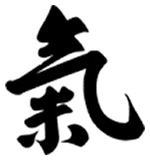 If this is confusing, don’t panic! The good news is that you don’t need to study any esoteric arts to understand how to put the ki into aikido. For some people ki may have a spiritual or mystical dimension – and that’s fine. For other people, ki is no more than a convenient shorthand term for a way of thinking and acting that has more to do with psychology and physics than parapsychology and metaphysics – and that’s fine too.
In Ki Aikido we talk a great deal about “extending Ki”. I like the description that Koretoshu Maruyama gives in his book, Aikido With Ki: “To extend ki is to have a positive spirit.” In my view, the simplest explanations are often the best and this, it seems to me, is a perfect summary of ki extension – a positive spirit. When you go to embrace someone you love you naturally extend ki. You don’t have to think about how to do it; it just happens.
In Ki Aikido, we have an exercise called ‘unbendable arm’ in which we learn to extend an arm and, even though we keep the arm loose and relaxed, it is very hard for someone to use force to bend the arm at the elbow. Beginners may find this exercise very hard to master. They constantly want to use strength, and tension, to ‘fake’ unbendable arm. To explain the feeling we are looking for, I sometimes ask a student to walk towards me and shake my hand. Assuming they are happy to do that (if they found me intimidating, the exercise would be counter-productive!) they generally find that the mere action of shaking my hand automatically gives them unbendable arm. That’s because they are naturally extending a positive feeling; it is no longer a difficult ‘test’; it is something that is easy to do without making a conscious effort.
That is a fundamental feature of ki extension. It isn’t a clever martial art technique at all. It is something that everyone does naturally. The secret is to be able to put yourself into a frame of mind in which that positive feeling is natural all the time – even when you are practising Aikido at high speed. It’s not something you turn on and off – it’s just there.
When students first get the feeling for ‘extending ki’, they are often surprised at how easy and natural it is. Prior to getting that feeling they often assume that is something that is incredibly difficult to achieve and not at all natural. But even those of us who have practised Aikido for a long time may sometimes lose that feeling: we allow ourselves to become tense, to try to do something with force rather than with a positive spirit. That is one of the reasons for all the many Ki development exercises we practise in Ki Aikido. Sometimes “doing what comes naturally” can be surprisingly difficult!
In different books on Aikido, you will find a number of different descriptions of Ki. In his book, The Spirit of Aikido, Kisshomaru Ueshiba (the founder’s son) describes Ki as “The world-forming energy which also lies at the core of each human being”. In Ki In Daily Life, Koichi Tohei (founder of Ki Aikido) describes ki as “the real substance of the universe”. In their classic text on Aikido, Aikido and The Dynamic Sphere, Adele Westbrook and Oscar Ratti describe ki as “inner energy” and they go on to state: “No ki – no Aikido.”
So, in short, what are we to make of this? Ki would seem to be some sort of energy that is both inside you and beyond you? And it is fundamental to Aikido. Which may make you wonder whether you need to be a physicist or a philosopher to understand ki. And, once you’ve understood it, you then have to find out how to use it in Aikido.
In Ki Aikido we talk a great deal about “extending Ki”. I like the description that Koretoshu Maruyama gives in his book, Aikido With Ki: “To extend ki is to have a positive spirit.” In my view, the simplest explanations are often the best and this, it seems to me, is a perfect summary of ki extension – a positive spirit. When you go to embrace someone you love you naturally extend ki. You don’t have to think about how to do it; it just happens.
In Ki Aikido, we have an exercise called ‘unbendable arm’ in which we learn to extend an arm and, even though we keep the arm loose and relaxed, it is very hard for someone to use force to bend the arm at the elbow. Beginners may find this exercise very hard to master. They constantly want to use strength, and tension, to ‘fake’ unbendable arm. To explain the feeling we are looking for, I sometimes ask a student to walk towards me and shake my hand. Assuming they are happy to do that (if they found me intimidating, the exercise would be counter-productive!) they generally find that the mere action of shaking my hand automatically gives them unbendable arm. That’s because they are naturally extending a positive feeling; it is no longer a difficult ‘test’; it is something that is easy to do without making a conscious effort.
That is a fundamental feature of ki extension. It isn’t a clever martial art technique at all. It is something that everyone does naturally. The secret is to be able to put yourself into a frame of mind in which that positive feeling is natural all the time – even when you are practising Aikido at high speed. It’s not something you turn on and off – it’s just there.
When students first get the feeling for ‘extending ki’, they are often surprised at how easy and natural it is. Prior to getting that feeling they often assume that is something that is incredibly difficult to achieve and not at all natural. But even those of us who have practised Aikido for a long time may sometimes lose that feeling: we allow ourselves to become tense, to try to do something with force rather than with a positive spirit. That is one of the reasons for all the many Ki development exercises we practise in Ki Aikido. Sometimes “doing what comes naturally” can be surprisingly difficult!
Saturday, 5 May 2012
Aikido Books - recommended
People often ask me to recommend books to help them to learn aikido. Here I’ve put together a short list of some of the aikido books that I find most useful and instructive.
Please bear in mind a few important points: 1) I would never recommend trying to learn aikido from a book alone. You must study with a qualified instructor. 2) This list is by no means comprehensive. There are many more books on aikido and some of them may be just as good as the ones listed below. However, these are the books that have proved most useful to me and I have no qualms in recommending them to other people. 3) Different ‘schools’ of Aikido (Ki, Iwama, Yoshinkan etc.) may use different variations on certain techniques. Moreover, each individual teacher may emphasise different approaches or use techniques that differ from those in these books. You should, of course, always follow your teacher’s advice. That said, I am very much of the opinion that students can learn from every great teacher. Even though my own ‘style’ is Ki Aikido, I am very open to learning from teachers of other styles and the books in my list are not all aimed specifically at students of Ki Aikido.
Aikido and The Dynamic Sphere is a superb book. While probably no single book can claim to be the ‘definitive’ reference to aikido, this book comes very close. It is available in hardback and in paperback. Even though it’s expensive, I’d say the hardback edition is worth every penny. It does a great job of describing the techniques of aikido in a coherent and well structured way. But what really makes this book so great are the illustrations. The techniques are superbly illustrated and many of them are annotated with arrows to show the direction of force in each movement. My only caveat is that the book is so detailed that it may be a bit overwhelming for a beginner. However, if you’ve been practising a technique and want to study it in detail outside the dojo, this book cannot be beaten.
Aikido Exercises for Teaching and Training. I’ve only discovered this book quite recently. It was recommended to me by one of the high-ranking teachers in the British Ki Aikido Association – and I am really glad of the recommendation. It’s terrific. In principle, it is aimed at teachers of aikido rather than students and it includes many very useful tips on how to teach certain tricky techniques and how to explain some of the underlying principles. But I have to say that the techniques themselves are so clearly explained that I think this would be a valuable book for learners as well as teachers. But if you are a teacher, consider this essential reading.
Aikido, The Co-ordination of Mind and Body for Self-defense. This is another ‘classic’ text. Written by Koichi Tohei under the supervision of Morihei Ueshiba (the founder of Aikido), the book was published in 1961 when Tohei was the chief instructor at Aikido Headquarters, many years before Tohei went on to found the ‘style’ of Ki Aikido. As a consequence, it may be regarded as an authoritative guide to Aikido as taught by Ueshiba at that time. This is a good reference to the essential techniques including the warm-up and ‘Ki Development’ exercises and it also has some short essays on the philosophy of aikido. It’s pretty well illustrated with some mostly rather grainy black-and-white photographs. Although not as slickly produced as some more modern books, it remains a good reference work. As far as I can see it is not currently in print but second-hand copies are available on Amazon and EBay.
Aikido With Ki. Written by Koretoshi Maruyama under the supervision of Tohei Sensei in the early ‘80s, this book covers, to a large degree, much of the same ground as Tohei’s Aikido (reviewed above). Once again, the essential techniques plus the warm-up and Ki Development exercises are described and photographically illustrated. By the time this book was published, Tohei Sensei had founded the style of Ki Aikido and this book has more explicit references to the principles of “Ki training. The techniques are well explained and – as an added bonus for black belts – there is an appendix on how to fold your hakama. I have to admit that this is one of the arts of aikido that, to this day, I cannot claim to have mastered! As with Tohei’s book, new copies of ‘Aikido With Ki’ may be hard to find but second-hand copies are available.
Now, since I teach Ki Aikido, ‘Dynamic Aikido’ may seem an odd choice. Written by Gozo Shioda, who founded the Yoshinkan school of aikido, several of the techniques described here are substantially different from the techniques as we normally practise them in Ki Aikido. Even the default ‘backward breakfall’ is different. Nevertheless, I have no hesitation in recommending this as one of my top books on aikido.
It’s worth knowing a bit about Shioda in order to understand why and how his style of aikido is a bit different from the style taught in other schools. Shioda was one of Ueshiba’s senior students. He began studying with Ueshiba in the early 1930s and eventually founded the Yoshinkan style in 1955. It is sometimes said that Shioda’s style is representative of an earlier and ‘harder’ style of aikido whereas Tohei’s style is based upon the softer style which Ueshiba developed later in life. Well, maybe there’s some truth in that. Though, anyone who’s practised Ki Aikido at a high level will tell you that ‘soft’ is certainly not the whole story! And I am not really sure that ‘hard’ is a correct description of Shioda’s style either. A better description might be that Shioda’s style is more direct with lots of ‘entering’ throws whereas Ki Aikido tends to be more indirect with lots of turning and deflecting throws. At any rate, if you have any doubt about just how good Shioda was, go and watch some of his videos on YouTube. He was one of the great masters and I defy anyone in any style of aikido to suggest that they are incapable of learning from him.
In my view, ‘Dynamic Aikido’ is one of the core texts of Aikido and deserves to be studied by practitioners of all aikido styles. It is beautifully illustrated both with line illustrations and with photographs of Shioda performing the techniques, many of the photos being annotated with lines and arrows to emphasises the critical angles and directions of force. A very good book indeed, even if some of the technical details may differ from those taught by other aikido styles.
And here is a short video review...
Subscribe to:
Posts (Atom)