Showing posts with label opinion. Show all posts

Sunday, 2 November 2014

Aikido – change and decay…

(…or maybe not?)

What is the ‘true’ path of Aikido? Did O-Sensei define all of Aikido from A to Z for all time? If that is the case, are we wrong to practise techniques in ways that were not precisely defined by O-Sensei?

I know that many people feel that only by performing each technique in a precisely defined manner are we being ‘true’ to Aikido. But there is an alternative point of view which sees the practice of Aikido as a process of constant discovery: since no person and no attack can ever be quite the same as any other person or any other attack, each defence may change subtly in response to (or ‘in harmony with’) each attack. While both arguments have merit I must admit that personally I feel more inclined towards the latter point of view. But am I right? After all, by allowing techniques to change don’t we risk straying away from the heart of Aikido and just ‘making it up as we go along’?
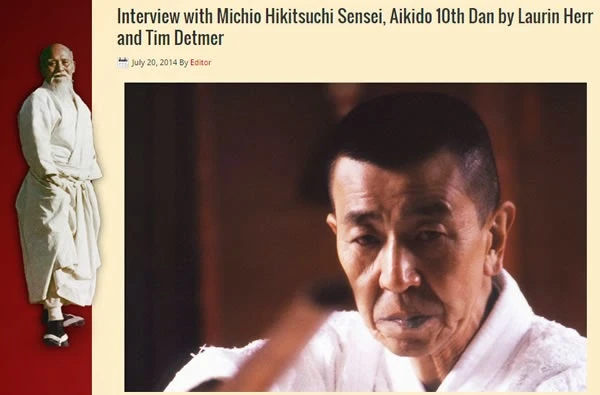
“I must not inject my own opinion or in any way distort the direct transmission of O-Sensei’s Way.” --- Michio Hikitsuchi (Aikido Journal Interview)
Some Aikido masters have indeed voiced concern about the potentially damaging effect of making changes to Aikido. This concern was powerfully expressed by Michio Hikitsuchi Sensei (10th dan)  who said in an interview with Aikido Journal: “I must simply convey to the world exactly what I learned from O-Sensei. That is my responsibility. So, I must say only what O-Sensei said and teach only what O-Sensei taught. Nothing else. I must not inject my own opinion or in any way distort the direct transmission of O-Sensei’s Way.”

Morihiro Saito Sensei was equally concerned with maintaining the true transmission of the techniques taught to him by O-Sensei. This is how Saito explained himself in an interview with Gaku Homma: “I feel it is my obligation to teach the Founder’s Aikido to as many students as possible. When I die, a direct link to his technique will disappear. I have been given the gift of 23 years of experience with the Founder…What I have learned, I have learned from him, and what I have learned, I feel compelled to teach. “

Should we not then accept the views of these two great masters?  They considered it important to transmit faithfully the unmodified practice of Aikido just as they were taught it by the Founder. So are we to regard it as fundamentally wrong, decadent even, to introduce any changes to that purest form of our art?
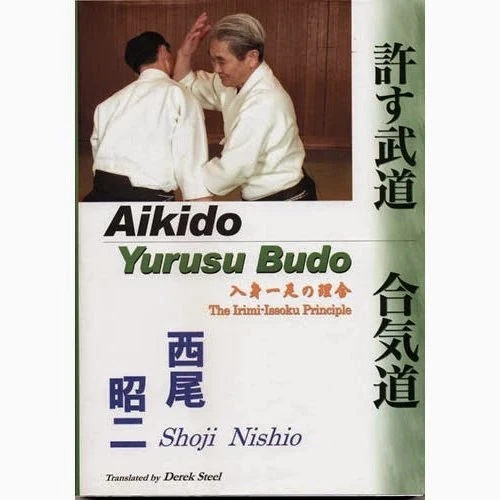
“I think it is insufficient – unforgivable, in fact – for us to simply maintain the status quo.” --- Shoji Nishio (‘Aikido Yurusu Budo’)
But let’s consider an alternative viewpoint. In his book ‘Aikido Yurusu Budo’ (available from http://store.Aikidojournal.com/), the great master Shoji Nishio argues that we should not be afraid of the idea of Aikido changing and evolving over time. On the contrary, he says that “Budo techniques are not permanent and unchanging; if other things change, then naturally budo change in response. What does not change, of course, is the spirit of Aikido as it was taught by the Founder.”

This reminded me of a story Koichi Tohei Sensei tells in his book “Ki In Daily Life”. One of his students, a man who had only recently been graded to 1st dan, had moved to the island of Guam. At that time there was no Aikido club on Guam and he asked Tohei Sensei how he would be able to continue his training. Tohei told him that if there was no teacher on Guam, the 1st dan must become the teacher. The man felt he was too inexperienced to do so but Tohei persuaded him that even though he only held the rank of 1st dan, he understood the guiding principles of Aikido and that was sufficient. In other words, Tohei was saying that the principles are more important than the precisely defined form.

Nishio Sensei says this in his book: “Before the Founder passed away thirty-four years ago he told us, ‘This old man has brought [Aikido] this far; all of you must take it from here.’ In light of these words, I think it is insufficient – unforgivable, in fact – for us to simply maintain the status quo.’”
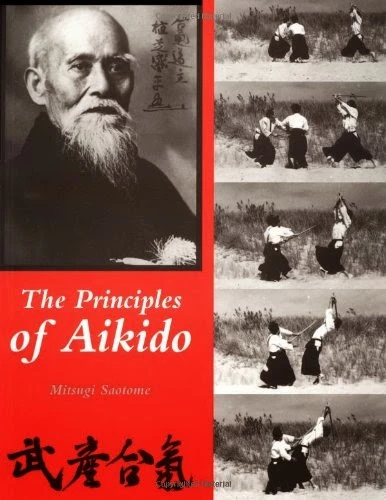
“Like language, [Aikido] has room for an infinite variety of creative uses of its elements and great elasticity of structure.” --- Mitsugi Saotome (‘Principles Of Aikido’)
Mitsugi Saotome Sensei in his book, ‘Principles Of Aikido’ http://www.amazon.co.uk/Principles-Aikido-Mitsugi-Saotome/dp/ expresses a similar idea; “I worry about the conflicts that I see arise between different styles and schools of Aikido,” he says, “People fight about which school is right, which one really represents O Sensei’s teaching. Some of these schools try to be claiming Aikido as if it were a brand name. This seems so unnecessary to me. No one can be an exact replica of O Sensei. Likewise, later generations of Aikido students cannot be identical copies of their teachers.”

Saotome argues that technical details do not mark out true Aikido. “If the principle and purpose are present,” he says, “any technique can be Aikido. If they are absent, so is Aikido.” He expands upon this idea in the book’s introduction: “No style – no particular set of forms – is, in and of itself, Aikido. You might think of Aikido as a language. As such it has its grammar and its rules, but that grammar is very broad and accommodating. Like language, it has room for an infinite variety of creative uses of its elements and great elasticity of structure.”

So what are we to make of this? Who is right: those who attempt to practise the techniques as closely as possible to the way they were taught by the Founder? Or those accept the principles but allow themselves great freedom in changing and developing the techniques?

In my view, this apparent conflict of ideas is false. It is simply the case that some people find it more satisfactory – more personally fulfilling – to practise and perfect what they might regard as the ‘canonical form’ of Aikido while others find equal fulfilment in experimentation, adaptation and evolution. And as Aikido is, for each practitioner, a personal journey, what is right for one person may by no means by right for all others.

I’ll give the final words to Saito Sensei (once again from his interview with Gaku Homma): “I would never say that Iwama-style Aikido is the only valid form of Aikido. Each instructor has his or her own individual character that is built on his or her cultural background and environment. It is only natural that different styles and different organizations have developed. Traveling all over the world has helped me to understand this, as I have come in contact with many different people, places, and cultures. I think it is good for students to learn from many different instructors and to practice at many different dojos.”

Thursday, 6 March 2014

Aikido Is Bullshit

No, I didn't say that! This is the opinion of Master Ken. And who am I to disagree? master Ken is, after all, the highest ranked (11th dan) martial artist on this or any other planet. Sadly there are no Ameri-do-te classes here in North Devon. So I guess I'll just have to stick with Aikido! ;-)

Sunday, 12 January 2014

You're never too old...

Not all of us in the Hartland Aikido Club (myself included!) are in the 'springtime of our youth'. But that doesn't stop us setting a pace that challenges the younger members.

Some people, as they grow older, slow down, do less exercise, tell themselves they should 'take it easy' at their time of life. I tend to go to the other extreme: the older I get, the less time I have to do all the stuff I want to do, so I accelerate the pace rather than slow it down.

I was interested to read this piece in The Washington Post recently, about a 70 year-old athlete and coach who seems to share my views. Joel Friel cycles for about two hours a day and also does weightlifting and plays golf. His activities are significantly different from mine. My exercise principally takes the form of aikido a few times a week and long walks with my dogs a few times a day. But the principle is the same: don't give give up, don't slow down. You may need to change your activities if your body can no longer cope or if you have specific health problems, but stopping them is simply not an option.

This is what Friel says about staying active in his 70s...
"I’m highly motivated. I always enjoy going for ride, but sometimes younger athletes, although they want to, they can’t. They have so many things in their lives that interfere [such as] trying to start a career and raise a family. I’ve been through that. Now I can do things as I want to do them. That’s one of the beauties of getting older: You have much more freedom in your life. I’m taking advantage of that in every way that I can."
Good advice, I think!

Thursday, 7 June 2012

Martial Arts, Self-Defence and the perception of risk


Or, to put it another way: why learn a martial art in North Devon?

I live in a beautiful, quiet, rural area of North Devon in the South-west of Britain. If asked to describe this area, ‘tranquil’ and ‘peaceful’ (rather than ‘violent’ and ‘dangerous’), are words that immediately spring to mind. I’d say the chances of being mugged down a dark alley (or down a dark country lane) are pretty small. So why on earth would anyone want to devote hours, weeks, months and years of hard work to learn a martial art?

Is this why you want to learn a martial art...?
Actually, even if you live in a big city – where the chances of being mugged may be higher – the same question is relevant. It all comes down to the perception of risk. While people certainly are mugged in London, Paris and New York, the chances that this will happen are relatively small. So, unless you happen to work in a profession where the risk of random violence is unusually elevated – if, for example, you are a policeman or policewoman, a bouncer or a security guard – your risk of injury or death from a violent attack will be significantly lower than from a variety of other possible causes.

Fighting and Falling


In 2011 The Guardian newspaper published a table of mortality statistics in England and Wales for the preceding five years. Let’s just look at the most recent figures (for 2009). This shows that there were 318 deaths from assault. It doesn’t state how many of these assaults were ‘on the street’ and how many were in the home or elsewhere. But, for the sake of argument, let’s assume the worst and imagine that a large number of these might have been ‘on the street’ assaults. That may sound scary. But wait a minute, let’s see how many people died in traffic accidents: 2,284. Yikes! And deaths from all types of accident: 11,917.  Now let’s see how many people died from falling –  3,593.  So it turns out that you have about 38 times the change of being killed by an accident and more than 11 times the chance of dying from falling than from being assaulted. 

But even that is nothing compared to the risks posed from ill health. The top killer was circulatory diseases  which accounted for 168,238 deaths. I won’t go down the rest of the list. It would be too depressing but you can read it here: http://www.guardian.co.uk/news/datablog/2011/jan/14/mortality-statistics-causes-death-england-wales-2009

The point is that, if you want to defend yourself against serious or fatal harm, learning to defend yourself against an attack on the street should not, logically, be at the top of your list of priorities. Top of your list should be maintaining a healthy lifestyle – that is doing all the things that doctors tell us can help us to maintain a healthy heart and circulation: good diet, regular exercise, lowering stress and so on.

Did I say “exercise”? “lowering stress”? Hmm…. isn’t Aikido pretty good at that?

And then, of course, there are all those deaths from falling. Now, I don’t think Aikido will help you much if you happen to fall from the top of the Eiffel Tower. But if you slip over a carpet or trip over a branch. Well, making a safe ‘breakfall’ an instinctive reaction could certainly help.

Life (and death) On The Street


The perception of risk ‘on the street’ is described this way in the excellent book, ‘Aikido Exercises For Teaching and Training’.
“What’s really On The Street is cars. You may be in a hurry, lost, angry or frightened – and so may the other person. Therefore practice ma-ai, patience, awareness, flowing and blending…
"What’s really On The Street is concrete. You may trip on the sub, slip on the ice, miss a step, break a wrist, an arm, a leg, a head. Therefore practice your rolls and ukemi.”
But let’s not minimise the importance of Aikido as a self-defence system that can indeed be used against a violent attack. Let’s consider what sorts of violent attacks you might encounter in your life. Violent attacks don’t always come from malicious strangers. They may also come from a family member or a friend. If you work in a pub or a hospital, an attack might come from a client or a patient. When dealing with such an attack you probably don’t want to use such force against the attacker that you will end up doing them serious damage. On the contrary, you just want to keep yourself safe and restrain the person attacking.

I once taught an Aikido course for ‘Crisis’ - a London-based organisation which looks after homeless people. Over the Christmas period, a number of volunteers assist in housing, feeding and caring for homeless people. The trouble is that sometimes those volunteers are attacked by the people they are caring for. The volunteers who attended my course wanted to know how they could avoid harm to themselves – while also avoiding harm to the person attacking them.

So, in short, while Aikido can be an effective form of self-defence against a violent ‘street’ attack, for most people this is unlikely to be the most practically valuable reason for learning Aikido. Of much more benefit are: learning to relax under pressure, taking regular exercise, learning to fall safely, learning to prevent an aggressive confrontation safely and – maybe most important of all – the sheer fun and satisfaction of learning a beautiful art that requires so much skill.


Saturday, 31 March 2012

What is the point of Aikido?


Why would anyone spend hours every week (or if you are really keen, hours every day) for many years (quite possibly until you finally shuffle off this mortal coil) learning Aikido?

What, in other words, is the point?

Here are some of the reasons that I’ve heard people give:

  • Self-Defence
  • Fitness
  • Calmness
  • Fun

There are probably others too, but that’s enough to be going on with. The trouble is that, taken on its own, no one reason is sufficient. Let’s consider them one by one.

Self-Defence

There are many arts of self-defence ranging from Karate to boxing, a can of mace-spray to a pair of knuckle-dusters. What do people mean when they say they want to learn ‘self-defence’ anyway? Maybe they have a fear that a mugger will leap out down a dark alley one night and demand all their money? Well, yes, that might happen. But for most people most of the time it won’t. And even if it does, the simplest form of self-defence would do give the mugger your money and worry about it later. To be honest, that is probably going to be a lot cheaper than spending years of your time and money learning Aikido.

Fitness

Once again, there are innumerable ways of getting fit – play a sport, take the dog for long walks, go swimming. It’s true that Aikido, practised regularly, builds both stamina and flexibility. Then again, as with any dynamic physical activity, there is always the risk of injury. Years ago, I hurt my knee after some particularly vigorous multi-person attack practice. When I saw the physiotherapist, I said, “Maybe I should give up Aikido?” His answer was: “Definitely not! While it’s true that people get injuries from physical activities, by far the worst problems I have to deal with affect people who don’t take regular exercise.” OK, so Aikido is generally good to maintain fitness. But not good enough, in my view, to make it worth practising with that goal alone as your ultimate aim.

Calmness

Aikido definitely is a great way of learning to keep calm under pressure. I can tell you from my own experience, that when I practise Aikido regularly, I can cope with most of the problems life flings in my direction. When I don’t practise Aikido regularly (and there have been long periods in my life when I haven’t had the opportunity) I react much more negatively to pressure. Trivial concerns of everyday life may seem like major problems. I remember when I was editing a magazine once and we were on deadline and everything and everyone was in a terrific panic, the deputy editor looked at me and said, “How can you stay so calm at a time like this?” I looked at her and said, “Last night I was being attacked by four black belts with knives. Believe me, editing a magazine is child’s play.” I was joking - but only slightly. The point is that just as Aikido had taught me to stay calm in a multi-person attack so it had taught me to stay calm in any high-pressure situation.

Fun

The enjoyment you get from an activity is entirely subjective. Some people love weight training. I don’t. I used to do it regularly but found it essentially dull. Other people like swimming or playing team sports. I don’t. I don’t get a thrill out of doing lengths up and down a pool or kicking a ball and scoring points. But I do find Aikido a lot of fun. Partly it’s the pure adrenaline rush: the joy of fast movement and dramatic break-falls. Partly it’s the intellectual fun of dealing with complicated and difficult attacks. It’s the same sort of joy some people get from playing chess. It’s puzzle-solving. But at high speed.

Other Things?

There are lots of other things that people get out of Aikido. For some it is learning coordination – becoming aware of exactly how to place their feet, move their arms and maintain a good posture with perfect balance. Or it may be that Aikido provides a purely mental pleasure – the meditative quality of working precisely on formal techniques such as katas. Or it may be simply the beauty and fluidity of movement – the dance-like grace and elegance of masterful Aikido.

So what is it about Aikido that continues to draw me to it after all these years? The simple answer would be “all of the above”. I enjoy learning practical defence techniques to maintain fitness, develop calmness and have fun. And, up to a point, that answer is true. But it’s not the whole truth.

The real truth is that my reasons for doing Aikido have changed over time. When I first took it up, in the early 80s, I was looking for a way of getting fit. I wasn’t looking for Aikido specifically. In fact, I tried several other martial arts (Wing Chun, Taekwondo and Karate) before chancing upon an Aikido class taught by Sensei David Currie. Sensei Currie was quite unlike the other martial arts teachers I’d practised with. He was so laid-back, so quiet and self-effacing, that I rapidly came to the conclusion he must either be very bad or very good and I’d better hang around for a few lessons to find out which. Luckily for me, it was the latter.

Once I’d committed to Aikido, I (as many new students do) started on the assumption that I would learn lots of self-defence skills with which to defeat ruthless criminals down dark alleys – and that was the whole ‘point’ of it. But the more I practised, the less important that began to seem. Soon I was getting so much of a kick out of doing the Aikido itself that my main reason for learning came to be, well, for the pleasure of learning. Aikido of itself became a sufficient end result. And that, fundamentally, is the joy that has stuck with me to this day.

Sunday, 25 March 2012

Aikido in the dark


At last week’s aikido class in Bucks Cross we did about ten minutes of practice in the dark! Some sort of strange punishment for my students? Nope, a power cut.

In the wilds of North Devon, power cuts are fairly regular occurrences. You learn to live with them. When one happened half way through our class we had two choices – either struggle to stack the mats away in the dark, or just carry on. We opted for the latter. There was a very dim emergency light still in operation so we could just about see where people were, but not much more than that. And, surprisingly, the absence of light was no obstacle to our practice. On the contrary, in fact. It was my impression that, if anything, the techniques were executed more smoothly in the darkness than when the hall was fully lit.

By chance, I happened to be reading a book called “Aikido exercises for teaching and training” by C. M. Shifflett this morning (a great book, by the way, which has much to offer to students as well as to teachers) in which there is a discussion of the problems of relying too much in aikido on what we see rather than what we feel or hear. What you see is obviously vitally important. On the other hand, sometimes, if an attacker is punching (for example), it is all too easy to concentrate too much on the hand rather than on the whole body. In darkness, that’s not an option.

I was struck by this observation from Shifflett’s book:
“To decrease the emphasis on the visual, simply turning out the lights and practicing in the dark can change everything. Classes held during power failures have been some of our most memorable experiences. Awareness of surroundings actually improves when students must rely on alternate senses.”
I’m tempted to practise ‘aikido in the dark’ more often in future. You have been warned!