
Amazing the things you can find on YouTube. I love this short video from 1933 in which an elegant young woman gives her male attacker a very rough time! The techniques here are taken from jiu-jitsu but they, or techniques very like them, also exist in aikido. And she still has time to adjust her makeup!
Showing posts with label self-defence. Show all posts
Showing posts with label self-defence. Show all posts
Wednesday, 7 October 2015

Monday, 5 October 2015
Self-Defence For Women!
(....not to mention votes)
There really is nothing new about women learning martial arts for practical self-defence. The BBC has just published an interesting article about the Sufragettes who, in the early part of the 20th Century, studied jiu-jitsu in order to deal with aggressive attacks (even by policemen!)
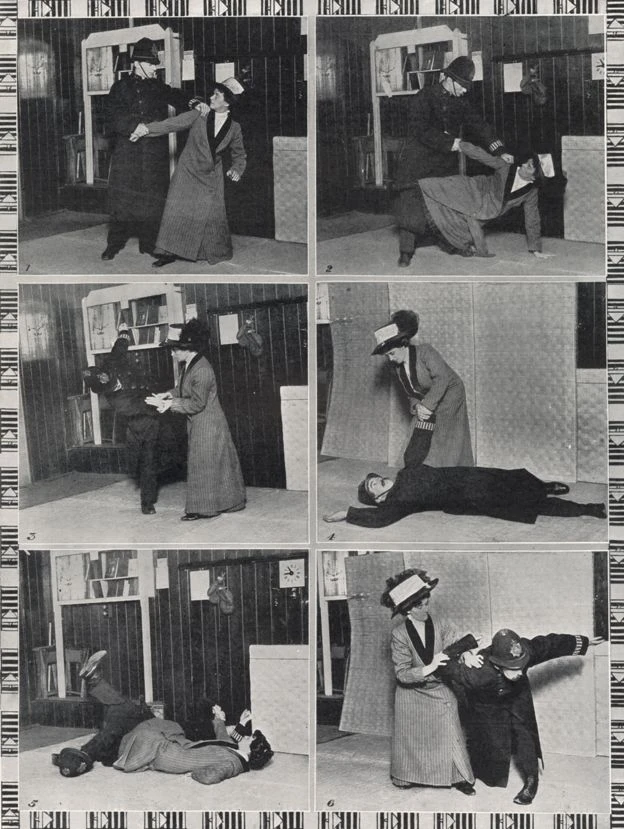
Aikido is based upon aiki-jui-jitsu and some of the best practitioners I've ever seen are women. The main quality of jiu-jitsu which attracted the suffragettes was (according to the BBC feature) that fact that it "emphasised using the attacker's force against them, channelling their momentum," which made it effective even when used by a small women against a large man. The same is true of aikido. In fact, aikido goes even further than jiu-jitsu in emphasising the importance of using the force of the attack in order to defeat the attacker.
Read the full article HERE.
There really is nothing new about women learning martial arts for practical self-defence. The BBC has just published an interesting article about the Sufragettes who, in the early part of the 20th Century, studied jiu-jitsu in order to deal with aggressive attacks (even by policemen!)
Aikido is based upon aiki-jui-jitsu and some of the best practitioners I've ever seen are women. The main quality of jiu-jitsu which attracted the suffragettes was (according to the BBC feature) that fact that it "emphasised using the attacker's force against them, channelling their momentum," which made it effective even when used by a small women against a large man. The same is true of aikido. In fact, aikido goes even further than jiu-jitsu in emphasising the importance of using the force of the attack in order to defeat the attacker.
Read the full article HERE.
Saturday, 12 April 2014
Street-fighting Aikido for self-defence!
Yes, yes, I know that Aikido is the art of peace and that we strive to find harmony and gentleness in our technique. But that is only part of the story. Aikido is also a practical method of self-defence. In fact, my favourite Aikido book, written in the early '60s by Koichi Tohei under the supervision of the Founder, Morihei Ueshiba, is called "Aikido, The Co-ordination of Mind and Body for Self-defense". In my view, you can only fully understand Aikido if you study both the mental and the physical aspects, the soft and the hard. I came across this video made by a Czech Aikido club this week, emphasising the self-defence aspect of Aikido. What do you think...?
Thursday, 11 April 2013
Aikido - tanto (knife) defences
Later this year I will be teaching classes on 'tanto tori' - defences against knife attacks. We will practise with wooden knives for safety. I've always found tanto defences one of the most challenging and interesting aspects of aikido. At black belt level you are expected to be able to perform these defences against real knives, so you need to have both the technical skill and also (just as important!) the calmness of mind to deal with whatever happens to come your way. Many years ago, when I used to practise with my teacher, Sensei David Currie, I undertook quite a long series of private lessons in which we explored defences against all kinds of weapons - from baseball bats to broken bottles.
Fear not! We won't be using any of those somewhat unconventional weapons in the Hartland club. We'll stick strictly to the wooden tantos. Here is a short video I came across of some basic tanto defences. Incidentally, this teacher (Mike Jones of the New York Aikikai) has a number of videos on YouTube. I recommend them. They are well filmed and Mike Jones is a very clear and engaging teacher.
Fear not! We won't be using any of those somewhat unconventional weapons in the Hartland club. We'll stick strictly to the wooden tantos. Here is a short video I came across of some basic tanto defences. Incidentally, this teacher (Mike Jones of the New York Aikikai) has a number of videos on YouTube. I recommend them. They are well filmed and Mike Jones is a very clear and engaging teacher.
Tuesday, 9 April 2013
Steven Seagal - on the effectiveness of aikido
It's pretty common for people who haven't studied Aikido to assert that it can't possibly be effective in 'real' situations. Steven Seagal has his say on this...
Tuesday, 12 March 2013
Self-defence for women!
Sadly we only have one woman member in the Hartland Aikido Club. I'm not sure if women have the impression that martial arts are for men only. That's absolutely not the case. We would love to have more women members. Just to give you some inspiration, here is a short video showing a woman doing Aikido in 'real life' which I happened to notice on YouTube... ;-)
Monday, 19 November 2012
Aikido, Martial Art or Self Defence?
“Aikido,” said Koichi Tohei in his book ‘Aikido, the Co-ordination of mind and body for self-defence’, “is known by the general public as one of the best arts of self defence”.
So there you have it. Aikido is a system of self-defence. But Aikido is also a martial art. Which raises the interesting question: so what’s the difference?
If you look up “martial arts” in the online dictionary, Dictionary.com you will see it is defined as:
“Any of the traditional forms of Oriental self-defense or combat that utilize physical skill and coordination without weapons, as karate, aikido, judo, or kung fu, often practiced as sport.”I find this definition profoundly unsatisfying. Let’s dispense at once with the most glaring error – the assertion that martial arts are “without weapons”. This is simply untrue. Many of the free-hand martial arts, including Aikido, also use weapons sometimes, while some martial arts such as kyudo (archery) and iaido (sword drawing) use weapons all the time.
I’ll also gloss over the sport element. Some martial arts are competitive, others are not. Most Aikido is not. And I won’t even enter into the debate about whether or not martial arts are necessarily Oriental (though it seems clear to me that not all are).
The bit of the definition that troubles me the most is the assertion that a martial art is a form of self-defence. Now, if you’ve never done a martial art, maybe you won’t understand why anyone would query that statement. Surely, you might think, it is self-evident that a martial art is a form of self-defence. Well, yes, they are – up to a point…
Now let’s then ask a different question: if all martial arts are forms of self-defence, are all forms of self-defence martial arts?
This question is easier to answer: NO!
The point I’m trying to make is that while a martial art such as Aikido certainly embodies a systematised form of self-defence, that is not necessarily its most interesting feature. There is more, much more, to Aikido than learning how to win a fight. Moreover, if you want to defend yourself against assault, Aikido is neither the fastest nor the most effective way of doing so. It’s not fast because it takes years of study even to master the very basic elements of Aikido. It’s not the most effective because the philosophy that underlies Aikido is fundamentally non-violent. Aikido will teach you all the things that you should not do in a fight: you should not deliberately try to hurt someone, you should not initiate a fight, you should do everything in your power to avoid using the most damaging techniques available to you. In short, when it comes to unarmed combat, Aikido puts all kinds of barriers in your way. If you just want to win a fight and you don’t care how much you hurt your opponent, Aikido is not the art for you.
Unarmed Combat?
Let me try to illuminate the difference between self-defence or ‘unarmed combat’ and a martial art such as Aikido, with a few quotations. These include quotations from two supreme martial artists: Morihei Ueshiba, founder of Aikido, and Koichi Tohei who was at one time Ueshiba’s chief instructor and later went on to found the style known as ‘Ki Aikido’. Contrast their words with some quotations taken from manuals of self-defence for members of the armed forces."The Way of the Warrior has been misunderstood. It is not a means to kill and destroy others. … To smash, injure, or destroy is the worst thing a human being can do. The real Way of a Warrior is to prevent such slaughter – it is the Art of Peace, the power of love."
(Morihei Ueshiba)
“In many cases, every man and woman may be called on to defend their lives in sudden emergencies. This defence can only be achieved by killing the enemy. To conquer our repugnance to killing at close quarters is essential.”
(‘All-in Fighting’, preface by Lt.-Colonel J P O’Brien Twogig)
“To injure an opponent is to injure yourself. To control aggression without inflicting injury in the Art of Peace.”
(Morihei Ueshiba)
“The majority of the methods shown are drastic in the extreme. In contrast to judo, they recognize no accepted rules…”
(‘All In Fighting’ by Captain A E Fairbairn)
“The martial arts begin with gratitude and end with gratitude. If there is an error at the important starting point, the martial arts can become dangerous to others and merely brutal fighting arts.”
(‘Aikido, the Co-ordination of mind and body for self-defence’ by Koichi Tohei)
“The edge of the hand blow and the chin jab, if applied as demonstrated in this manual, will quickly convince the student that in a matter of days he has developed a blow that is not only as effective as a good punch with the fist, but one which permits him to obtain a knock-out…”
(‘All In Fighting’ by Captain A E Fairbairn, British World War 2 army fighting manual)
“It takes time to train the mind and body to react to each set of conditions instinctively and in the prescribed method. This is one of the weaknesses of the jiu jitsu technique. By certain manoeuvres and movements, a jiu jitsu expert can place an antagonist in the proper position; but for the layman it is much too complicated and, according to American standards, takes too long to learn.”
(‘Kill Or Get Killed’ by Lt. Colonel Rex Applegate, US Marine Corps manual)
“Do not be in a hurry, for it takes a minimum of ten years to master the basics.”How, then, can Aikido be both a martial art and a system of self-defence? Consider this:
(Morihei Ueshiba)
“The art of self-defence must be one that can be used in a real fight. … If your opponent wants a no-holds-barred scrap, it will be he who decides how he should attack you and you cannot call foul at anything he does…. In Aikido, you practise always to adapt yourself to real fights.”
(‘Aikido, the Co-ordination of mind and body for self-defence’ by Koichi Tohei)
Self-Defence in Aikido
Last weekend I attended a very enjoyable course given by Sensei John Gaynor, the President of the Aikido Union of England. His style of Aikido is slightly different than the style (Ki Aikido) which I normally practise. Actually, it is not as different as you might think. In Ki Aikido we spend more time working on the ‘inner’ aspects – the calmness, relaxation and so on – and we generally don’t emphasise certain self-defence elements such as atemi (punches, kicks etc.) until students are quite experienced. But in essence we are all practising the same art and the differences are more a matter of differing emphasis rather than a fundamental disagreement.I found this short video in which Sensei Gaynor illustrates the use of atemi. Bearing in mind the topic of the discussion above, I think it’s interesting how he makes a distinction between the “lovely movement” used in the martial art and the somewhat more brutal approach to the same technique if you had to do it “for real”. It’s a good example of both the martial art and the self-defence aspects of Aikido and the subtle difference between the two…
Friday, 28 September 2012
Self-defence in North Devon
No, I really haven't spent years studying Aikido on the off-chance that one day I'll be able to defend myself against rampaging Ninja hordes on the streets of North Devon. In fact, if you really want to defend yourself against injury, learning a martial art can be useful in ways that have nothing to do with fighting. Read more in my latest article for the Bideford Buzz.
Tuesday, 28 August 2012
Self-defence in Bideford!
The topic of my latest article in The Bideford Buzz (our local magazine in this part of North Devon) was suggested to me by the editor. Nameley: how to stay safe on the streets at night.
The good news is that people usually greatly overestimate the risk of unprovoked attacks, as you can read: http://bidefordbuzz.org.uk/2012/08/keep-safe-on-the-street/.
It turns out that people also routinely underestimate other sorts of risk. And I'll have more to say about that in next month's issue.
Thursday, 7 June 2012
Martial Arts, Self-Defence and the perception of risk
Or, to put it another way: why learn a martial art in North Devon?
I live in a beautiful, quiet, rural area of North Devon in the South-west of Britain. If asked to describe this area, ‘tranquil’ and ‘peaceful’ (rather than ‘violent’ and ‘dangerous’), are words that immediately spring to mind. I’d say the chances of being mugged down a dark alley (or down a dark country lane) are pretty small. So why on earth would anyone want to devote hours, weeks, months and years of hard work to learn a martial art?
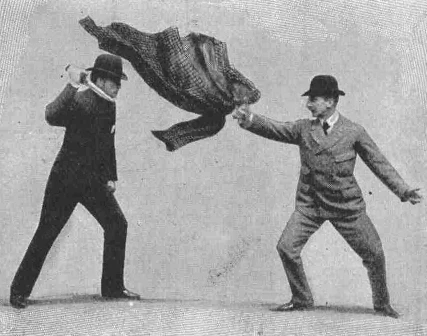 |
| Is this why you want to learn a martial art...? |
Fighting and Falling
In 2011 The Guardian newspaper published a table of mortality statistics in England and Wales for the preceding five years. Let’s just look at the most recent figures (for 2009). This shows that there were 318 deaths from assault. It doesn’t state how many of these assaults were ‘on the street’ and how many were in the home or elsewhere. But, for the sake of argument, let’s assume the worst and imagine that a large number of these might have been ‘on the street’ assaults. That may sound scary. But wait a minute, let’s see how many people died in traffic accidents: 2,284. Yikes! And deaths from all types of accident: 11,917. Now let’s see how many people died from falling – 3,593. So it turns out that you have about 38 times the change of being killed by an accident and more than 11 times the chance of dying from falling than from being assaulted.
But even that is nothing compared to the risks posed from ill health. The top killer was circulatory diseases which accounted for 168,238 deaths. I won’t go down the rest of the list. It would be too depressing but you can read it here: http://www.guardian.co.uk/news/datablog/2011/jan/14/mortality-statistics-causes-death-england-wales-2009
The point is that, if you want to defend yourself against serious or fatal harm, learning to defend yourself against an attack on the street should not, logically, be at the top of your list of priorities. Top of your list should be maintaining a healthy lifestyle – that is doing all the things that doctors tell us can help us to maintain a healthy heart and circulation: good diet, regular exercise, lowering stress and so on.
Did I say “exercise”? “lowering stress”? Hmm…. isn’t Aikido pretty good at that?
And then, of course, there are all those deaths from falling. Now, I don’t think Aikido will help you much if you happen to fall from the top of the Eiffel Tower. But if you slip over a carpet or trip over a branch. Well, making a safe ‘breakfall’ an instinctive reaction could certainly help.
Life (and death) On The Street
The perception of risk ‘on the street’ is described this way in the excellent book, ‘Aikido Exercises For Teaching and Training’.
“What’s really On The Street is cars. You may be in a hurry, lost, angry or frightened – and so may the other person. Therefore practice ma-ai, patience, awareness, flowing and blending…
"What’s really On The Street is concrete. You may trip on the sub, slip on the ice, miss a step, break a wrist, an arm, a leg, a head. Therefore practice your rolls and ukemi.”But let’s not minimise the importance of Aikido as a self-defence system that can indeed be used against a violent attack. Let’s consider what sorts of violent attacks you might encounter in your life. Violent attacks don’t always come from malicious strangers. They may also come from a family member or a friend. If you work in a pub or a hospital, an attack might come from a client or a patient. When dealing with such an attack you probably don’t want to use such force against the attacker that you will end up doing them serious damage. On the contrary, you just want to keep yourself safe and restrain the person attacking.
I once taught an Aikido course for ‘Crisis’ - a London-based organisation which looks after homeless people. Over the Christmas period, a number of volunteers assist in housing, feeding and caring for homeless people. The trouble is that sometimes those volunteers are attacked by the people they are caring for. The volunteers who attended my course wanted to know how they could avoid harm to themselves – while also avoiding harm to the person attacking them.
So, in short, while Aikido can be an effective form of self-defence against a violent ‘street’ attack, for most people this is unlikely to be the most practically valuable reason for learning Aikido. Of much more benefit are: learning to relax under pressure, taking regular exercise, learning to fall safely, learning to prevent an aggressive confrontation safely and – maybe most important of all – the sheer fun and satisfaction of learning a beautiful art that requires so much skill.
Subscribe to:
Posts (Atom)